
Source
The exact canonical page and preferred language.
Emelyn reads an approved webpage, shows what it found, flags claims that need checking, and helps you choose one useful job before it writes anything.
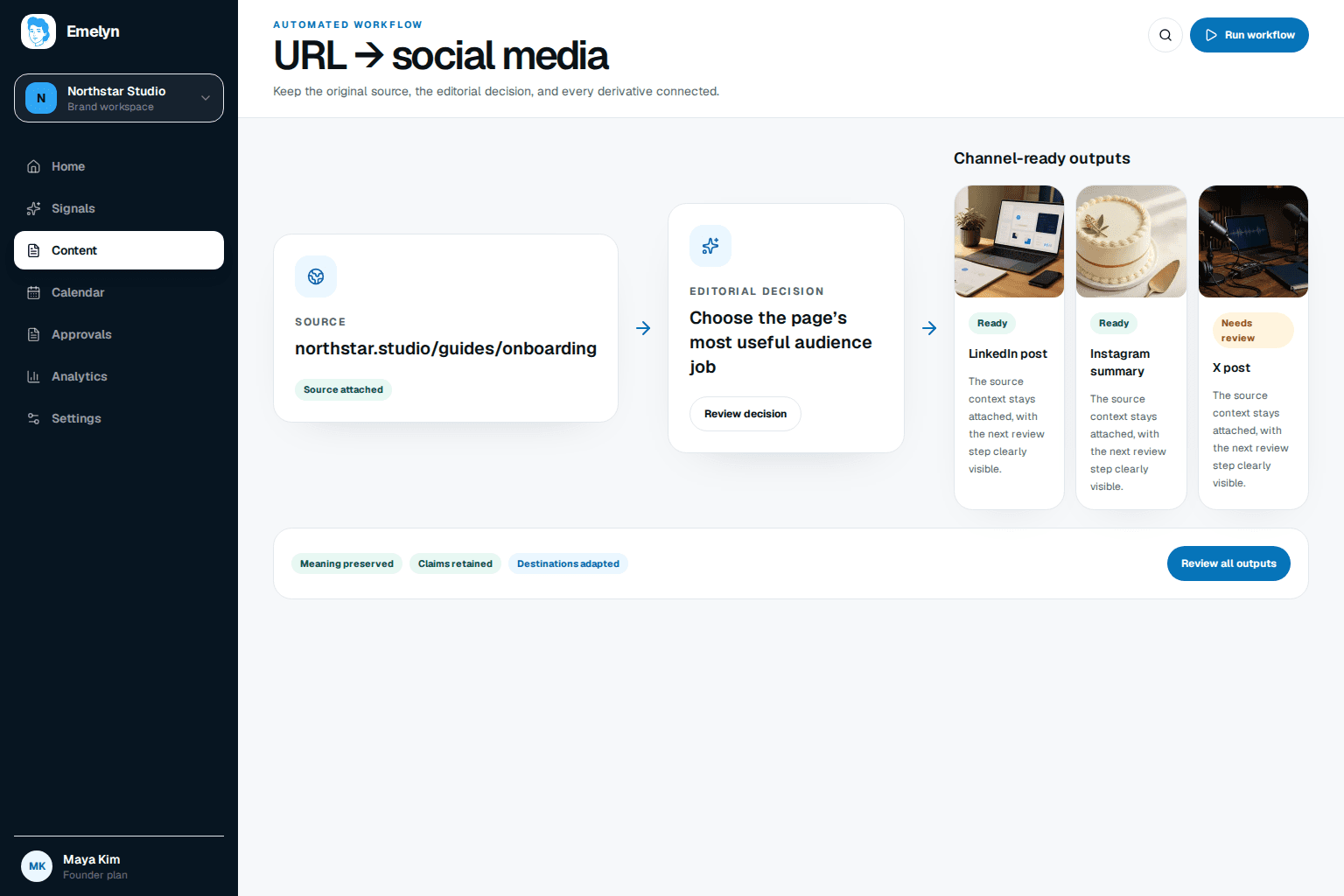
You confirm that the page is the intended source, that Emelyn may process it, and which parts are safe to reuse.
The exact canonical page and preferred language.
No login bypass, private link guessing, or hidden-page discovery.
The text, quotes, and images you are allowed to reuse.
The source date and claims likely to change.
Every passage receives a visible state. You can change the selection, attach missing context, or reject the source.
A useful explanation or example that can stand alone.
Background needed to keep the selected idea accurate.
A date, number, quote, permission, or claim that needs a person.
Navigation, filler, or a section that does not support the post’s job.
Claim check
“41% finish setup in one day.”
Source date: 2023
The claim cannot move into a 2026 post until someone checks whether the measure, sample, and result are still current. The rest of the idea can continue without it.
Without a job, URL tools tend to produce a bland summary. The job determines which idea is selected, how much context it needs, and what belongs in the call to action.
Explain one useful idea without asking for a click first.
Turn a real tension into a focused audience question.
Give enough value in the post, then offer the source as the next step.
The teaching post explains the step most onboarding guides skip. The X thread gives readers a four-part setup check. Both link back to the same source, but neither is a pasted summary.
LinkedIn · Teach
Help users name the first win before showing them every feature.
X · Checklist
Goal, first value, early help, and a learning signal—each given its own step.
Review required because one source claim is stale.
See approval workflowsThe source state stays visible from extraction through publishing.
Ask for an approved file or pasted source. Do not work around access controls.
Show the difference and reopen review for affected claims.
Remove it or hold the draft until someone verifies the definition and date.
Stop extraction and ask for the intended source.
Use it as research only. Do not reproduce protected wording or images.
Emelyn records the exact source version, destination, approval, publishing result, and job. Measure qualified visits for action posts, useful replies for discussion posts, and saves or follow-up questions for teaching posts.
Strategy update
If the onboarding explanation outperforms other teaching posts, strengthen that audience problem in the content plan and update the source before reusing it.
The current Google results are dominated by instructions for adding links or finding social URLs. This workflow therefore has to explain the job immediately: it is about turning an approved webpage into useful content, not creating a share link.
Current SERP example: creating link postsUse a source you are allowed to process. Public access does not automatically grant permission to reproduce the page’s wording, images, or gated material.
Not by default. It separates useful ideas from background, asks what the post should do, and develops only the passages that can support that job.
The fetched time and source stay attached. A material source change can pause scheduled content and reopen the affected claims for review.
Pillar
Select a supported idea and rebuild it for the destination instead of posting a pasted summary.
ExplorePlatform
Choose the author, proof, format, and audience response for the selected source idea.
ExploreIntegration
Map one approved CMS collection and begin only when the selected item is public.
ExploreFree tool
Adapt one true message while keeping each platform's job visible.
Explore