
Protect the main claim
Record what the source actually argues, which facts support it, and what would change its meaning before creating anything new.
Content repurposing means taking a useful source and creating new pieces from its central claim, evidence, examples, or story. Emelyn helps you choose a different job for each piece, so an article, video, or conversation becomes channel-native content rather than the same excerpt posted everywhere.
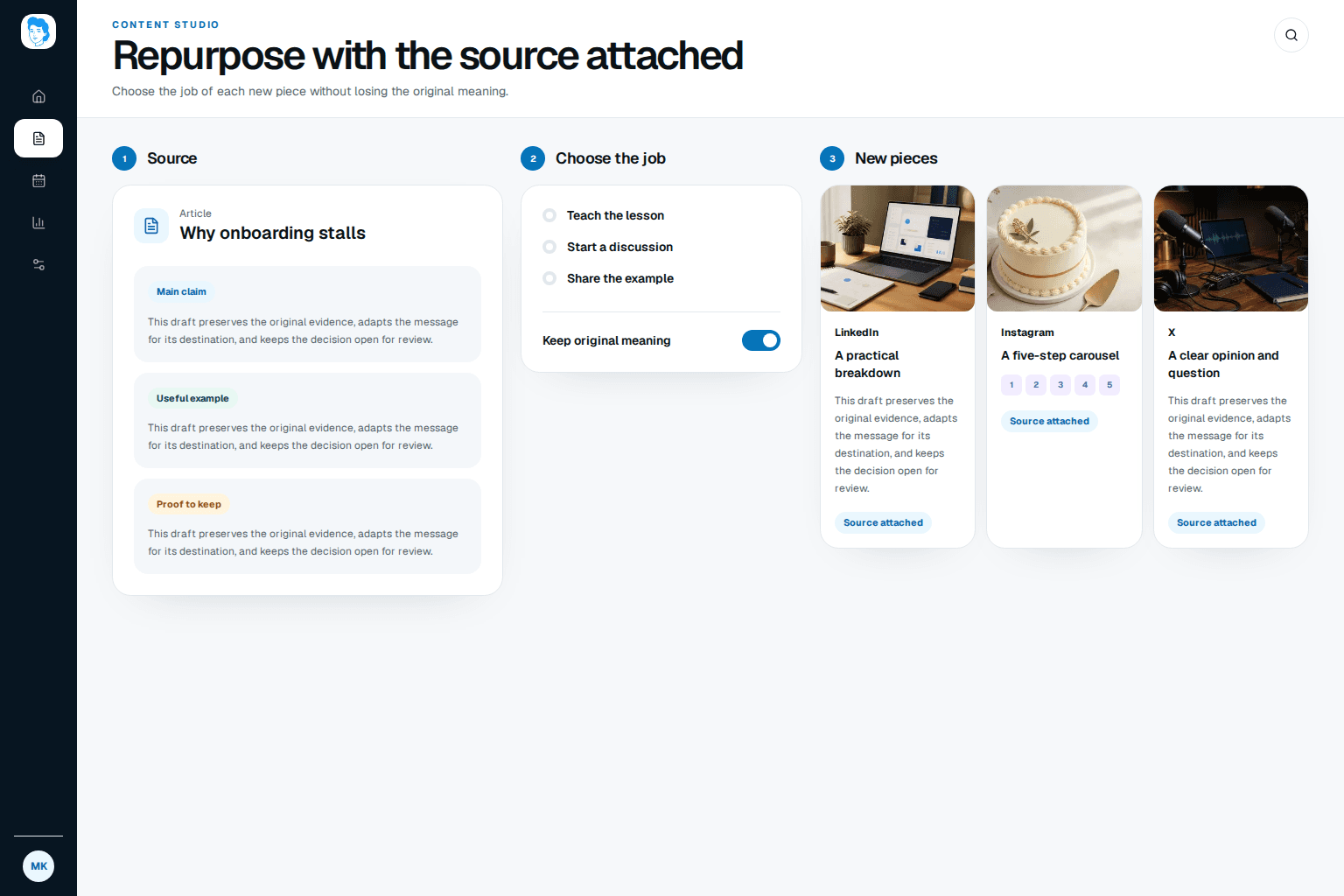
The source may contain a sharp claim, a useful process, a surprising example, and an unanswered question. Those are different pieces—not four copied summaries.
Record what the source actually argues, which facts support it, and what would change its meaning before creating anything new.
One post can explain, another can challenge an assumption, a carousel can teach the steps, and a question can invite useful replies.
Choose the opening, length, format, proof, and call to action that fit how people use that channel instead of pasting the same caption.
The goal is to develop the useful parts of the conversation without turning a customer's words into a claim they did not make.
Four pieces that serve different audience needs while remaining faithful to one verified source.
Repurposing begins with trusted content, passes through a new audience job, and ends by showing which part deserves deeper development.
Extract the main claim, proof, examples, boundaries, and language that should not be distorted.
Decide whether each piece should teach, persuade, start a conversation, support a launch, or answer an objection.
Create the right hook, structure, format, and level of detail for each channel and audience moment.
See which claim, example, or question earned useful attention and feed that learning into the next source.
Extraction, variation, and formatting can move quickly. Accuracy, permission, and whether a piece adds value remain human decisions.
The useful difference is whether each new piece preserves the source and earns its own reason to exist.
| What changes | By hand | Scheduler | AI generator | Emelyn |
|---|---|---|---|---|
| Starts from | A source you read and break apart | Finished posts | A prompt or pasted excerpt | A mapped source with claims, proof, examples, and boundaries |
| Creates | Whatever formats you have time to make | Nothing new | Fast variations or summaries | Pieces with distinct jobs and channel-native structures |
| Protects meaning | Your notes and attention | Outside its job | Depends on the prompt and review | Keeps the claim and evidence visible beside the draft |
| After publishing | You compare results yourself | Shows delivery and metrics | Stops at creation | Shows which part of the source earned further development |
Content repurposing is the process of taking a useful existing source and creating new content from its claims, proof, examples, story, or questions for another format, channel, audience moment, or purpose.
No. Reposting distributes the same piece again. Repurposing creates a different piece from the source material, with its own structure and job.
Useful sources include articles, videos, podcasts, webinars, interviews, customer questions, research, product updates, presentations, and strong social posts. Start with material that contains a clear idea and trustworthy evidence.
Only as many as the source can support without repetition or distortion. A rich interview may support several pieces; a short announcement may support one or two. Quality of the new job matters more than the count.
It can get much closer when it receives the full source, the claim to preserve, channel expectations, voice examples, and a clear job for each piece. Human review is still needed for meaning, originality, and facts.
Discover timely questions and conversations worth developing.
Give each new piece a purpose, status, and realistic date.
See which claim, example, or format is worth continuing.
Turn one real audience question into reviewed posts.
Choose the video job, release package, source path, and next useful treatment.
Turn a durable source into a useful Pin with a clear search intent and destination.
Help finished work travel farther without flattening the creator's voice.