
Cost
Everything spent to create the result
- Your time
- Freelance or staff cost
- Production
- Software
- Paid distribution
- Creator or partner fees
Social media ROI compares attributable value with the full cost of creating and distributing the work. Use the formula ((value − cost) ÷ cost) × 100. The arithmetic is simple; deciding what value social can fairly claim is the important part.
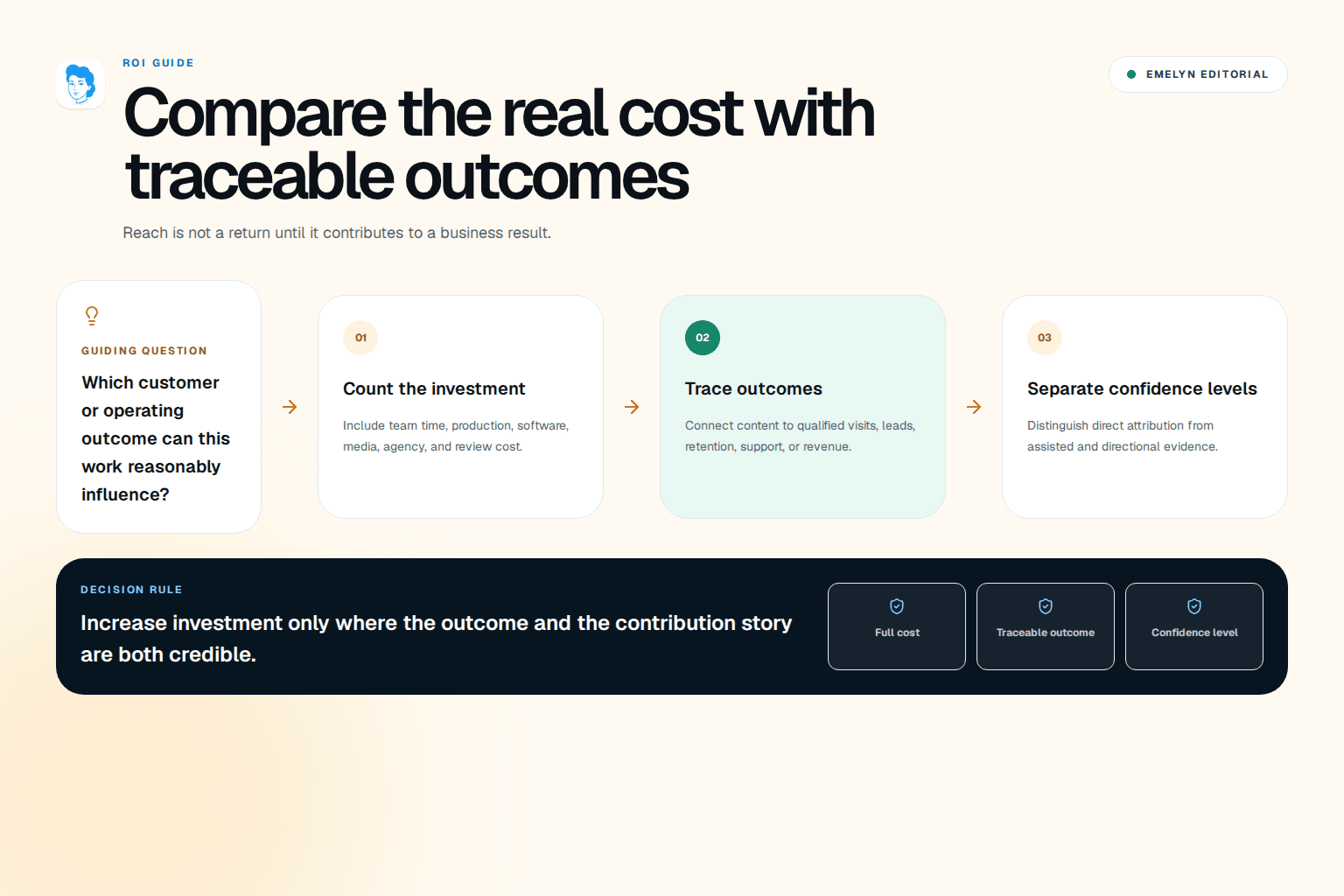
A “free” organic post still uses time, production, tools, and often review. Leaving those out makes the result look better than the business reality.
Cost
Value
01
A tracked link, code, form, booking, checkout, or CRM record connects the action to social.
02
The customer journey includes a recorded social touch, but other channels also contributed.
03
The outcome may have been helped by social, but the current evidence cannot assign credit.
UTM parameters can identify the campaign that referred a website session. They do not, by themselves, prove that the social post caused a purchase or capture somebody who saw a post and returned another way.
This fictional example uses contribution after the direct cost of each booking, not top-line sales.
$240 of owner time, $100 of photography, and $60 of software: $400 total.
Ten tracked bookings create $60 contribution each: $600 total. Two untracked enquiries are reported separately.
(($600 − $400) ÷ $400) × 100 = 50%
Repeat the campaign once, keep the same tracking, and test one lower-cost production method. Do not count the two enquiries as revenue until their outcome is known.
Choose the booking, purchase, lead, retention, saving, or other value the work should support.
Use a trackable link, code, form field, CRM source, or another declared method.
Decide which time, tools, production, fees, and distribution belong in the calculation.
State what the method will miss before a strong result creates pressure to overclaim.
Research method: live US-English Google and DataForSEO results, current ROI guides, Google Analytics campaign documentation, Reddit discussions about attribution and business outcomes, and local Emelyn prospect evidence, checked 29 August 2026.
Google Analytics campaign URLs Hootsuite ROI guide Attribution discussion
Editorial status: author and reviewer unassigned; last checked 29 August 2026. Corrections: hello@emelyn.ai.