
01
Approved examples
A small set of writing that clearly sounds right.
Emelyn learns from approved examples, then shows the patterns it found with evidence. You add plain use and avoid rules, approved claims, and boundaries. Every revision can be checked against something real—not vague adjectives such as bold, authentic, or professional.
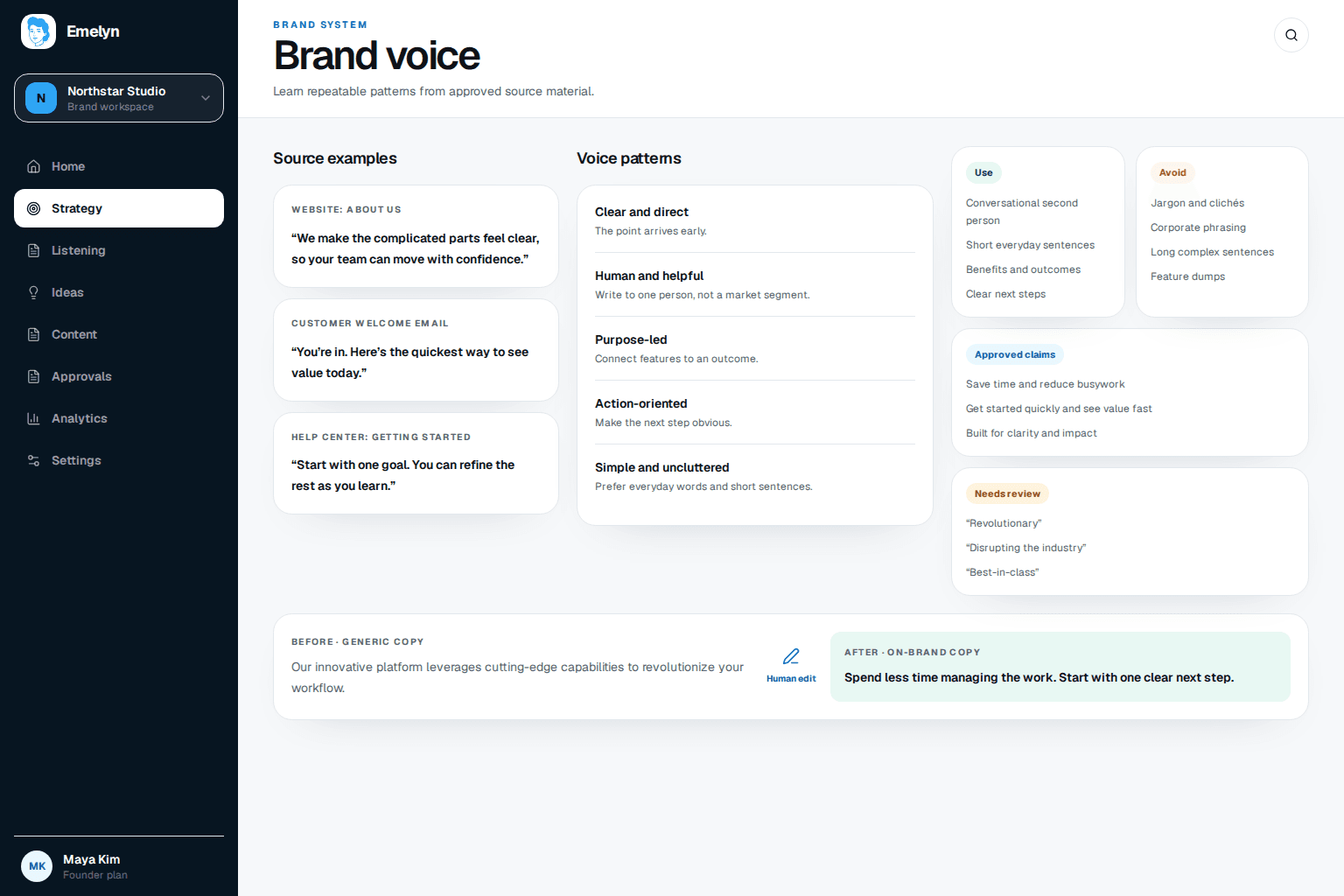
Useful voice guidance shows the examples behind a pattern, defines what to do and avoid, protects approved claims, and learns only from corrections a person deliberately approves.
01
A small set of writing that clearly sounds right.
02
Writing, phrases, and habits that should not shape the voice.
03
What the brand believes, notices, and refuses to flatten.
04
Concrete instructions that can improve an actual sentence.
05
What may be said, which source supports it, and where caution belongs.
06
Human edits that should improve future work—not every one-off change.
When examples conflict, Emelyn surfaces the disagreement. It does not average the writing into a bland middle.
Approved evidence
“Name the practical trade-off before making the recommendation.”
The rule points back to representative writing and helps an editor choose what to change.
Rejected evidence
A polished campaign line that nobody wants repeated.
An outlier can stay useful for that moment without teaching every future draft the wrong lesson.
Workflow 01
Past posts sound distinctive, but the qualities have never been written down.
New drafts have a clear editing standard without copying old sentences.
Workflow 02
A draft is accurate but sounds generic or overly polished.
The correction improves future drafts without silently changing the whole voice.
A casual edit should not rewrite the brand for every future draft.
Voice is more than recurring words and sentence length.
Emelyn surfaces the disagreement instead of averaging it into bland copy.
Part of Emelyn. Voice sources and brand profiles follow the account limits shown on Pricing.
See pricingThe person behind the voice needs to recognize the thinking and language. Anyone helping with the writing needs a clear reason for every change.
Start with a small, representative set that clearly sounds right. Quality and range matter more than uploading every sentence ever written.
No. Examples teach patterns and boundaries. New content still needs a distinct idea, source, purpose, and channel context.
Yes. Each brand profile keeps its own examples, rules, claims, boundaries, and approval history.
Compare how the same voice survives a newsletter and a podcast, then see the creator workflow and practical writing guide.
Practical guide
Turn approved and rejected examples into concrete rules and a reusable edit loop.
ExploreEditing guide
Diagnose missing substance, borrowed structure, and flat rhythm before polishing the words.
ExploreFollow the workflow
Keep the original meaning while changing the treatment for each channel.
ExploreEditorial workflow
Map standalone ideas while protecting voice and subscriber-only material.
ExploreBest-fit workflow
Protect an original voice while giving finished work a longer life.
ExploreUse the voice
Apply voice rules to a source-backed brief and channel-native draft.
ExploreFree tool
Turn approved writing into concrete patterns, boundaries, and edit checks.
ExploreAudio workflow
Protect the host's voice while choosing the few episode assets worth making.
Explore