
01
Keep
Repeat the supported pattern without copying the surface.
Emelyn compares posts that were trying to do the same job, keeps the original hypothesis beside the result, and produces a clear keep, try, or stop decision. Confidence and data gaps stay visible before that learning changes the strategy.
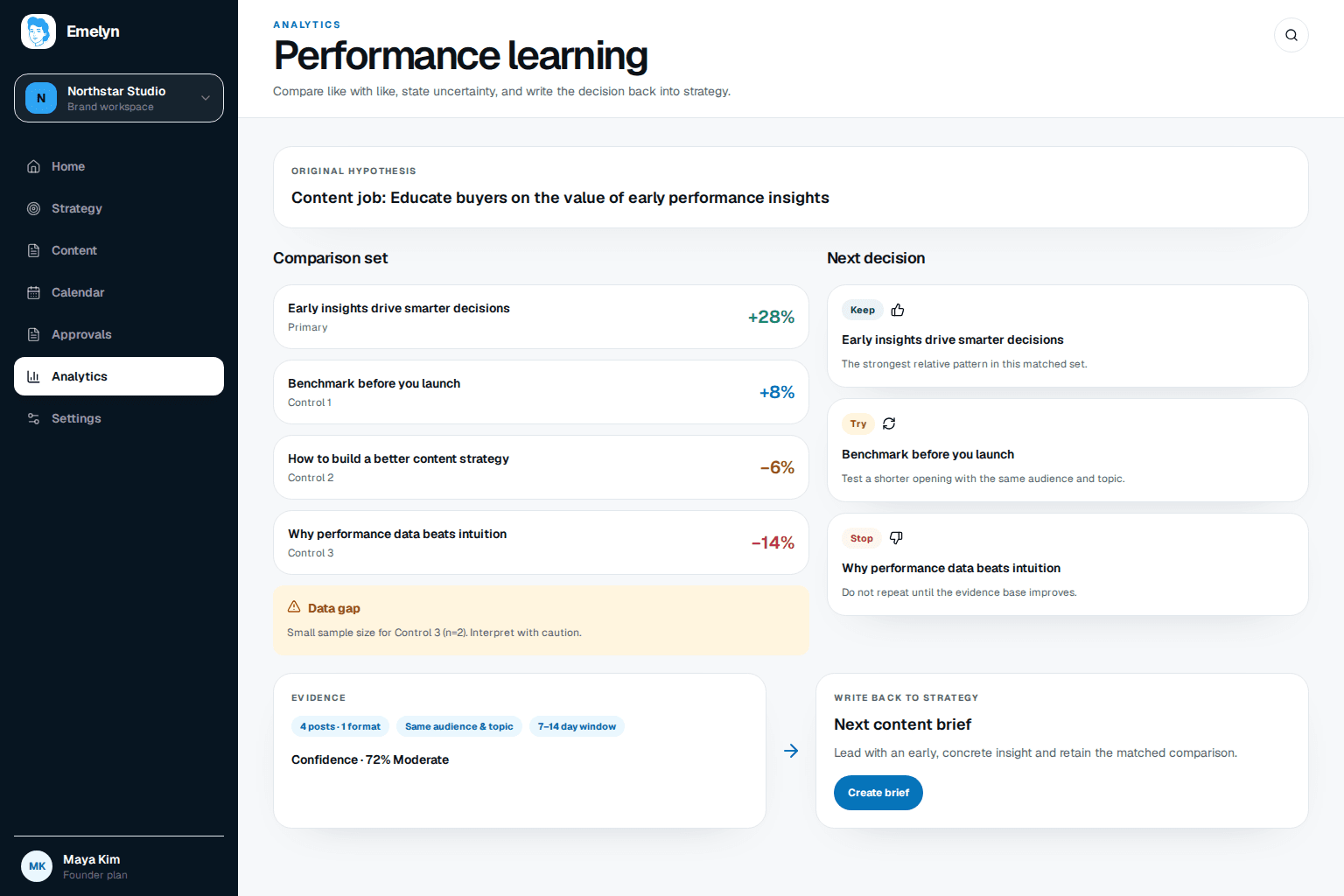
Reach, clicks, saves, replies, leads, and sales can answer different questions. Start with the content job, then choose evidence that can inform the next decision.
01
Keep the job and chosen measure from before the post went live.
02
Group only posts with a useful audience, job, topic, format, and time match.
03
Show definitions, sample size, missing data, and downstream outcomes separately.
04
Treat a small or messy pattern as a test—not a universal conclusion.
05
Turn the result into one keep, try, or stop decision for future work.
01
Repeat the supported pattern without copying the surface.
02
Change one thing and name the evidence the next test needs.
03
Retire work that repeatedly fails its intended job or no longer fits the strategy.
Workflow 01
One post outperforms the recent average, but the reason is not yet clear.
The next post builds on a specific lesson instead of copying the surface format.
Workflow 02
A post underperforms, but the sample is small and the platform data is incomplete.
A measured experiment replaces the temptation to abandon the whole strategy.
Reading a report and changing future direction are separate actions.
Social results are affected by platform distribution, timing, audience mix, and many uncontrolled factors.
Emelyn labels the gap and recommends the next measurement instead of manufacturing certainty.
Part of Emelyn. Data history, connected accounts, and reporting usage follow the account limits shown on Pricing.
See pricingReleases, articles, customer proof, and market education all do different jobs. Their results should improve the next brief at the right level.
No. Metric definitions and platform contexts can differ. Emelyn keeps definitions visible and compares only measures that support the same question.
It can create a useful hypothesis, but a broad strategy change should reflect the evidence strength, comparable history, and confidence.
The gap is shown beside the result. Emelyn can narrow the conclusion, extend the observation window, or propose the next test.
See how different content jobs are measured, how experiments stay honest, and how an agency keeps each client's learning separate.
Experiment guide
Set one question, one changed variable, one primary measure, and one next decision.
ExploreMeasurement guide
Match platform signals and business outcomes to the job of the content.
ExploreTiming experiment
Use benchmarks to start, then compare like-for-like posts with your own audience data.
ExploreLive-signal workflow
See whether a timely angle should change a durable strategy after the moment passes.
ExploreSource workflow
Separate asset reach, episode starts, listening, and useful questions.
ExploreBest-fit workflow
Turn each client's comparable results into a clear next recommendation.
ExploreCategory guide
Understand useful measurement and reporting choices.
ExploreOutcome integration
Carry tagged visits into a careful observed-outcome view without claiming perfect attribution.
ExploreEditable template
Keep competitor observations separate from your evidence, action, and learning.
Explore