
Too broad
Warm, confident, approachable, playful.
Thousands of brands can claim the same four words. None of them tells an editor what to change.
A useful AI brand-voice guide shows what sounds right, what sounds wrong, the point of view behind the writing, the words your audience uses, and concrete edit rules. “Friendly, confident, and authentic” is too broad to guide a sentence.
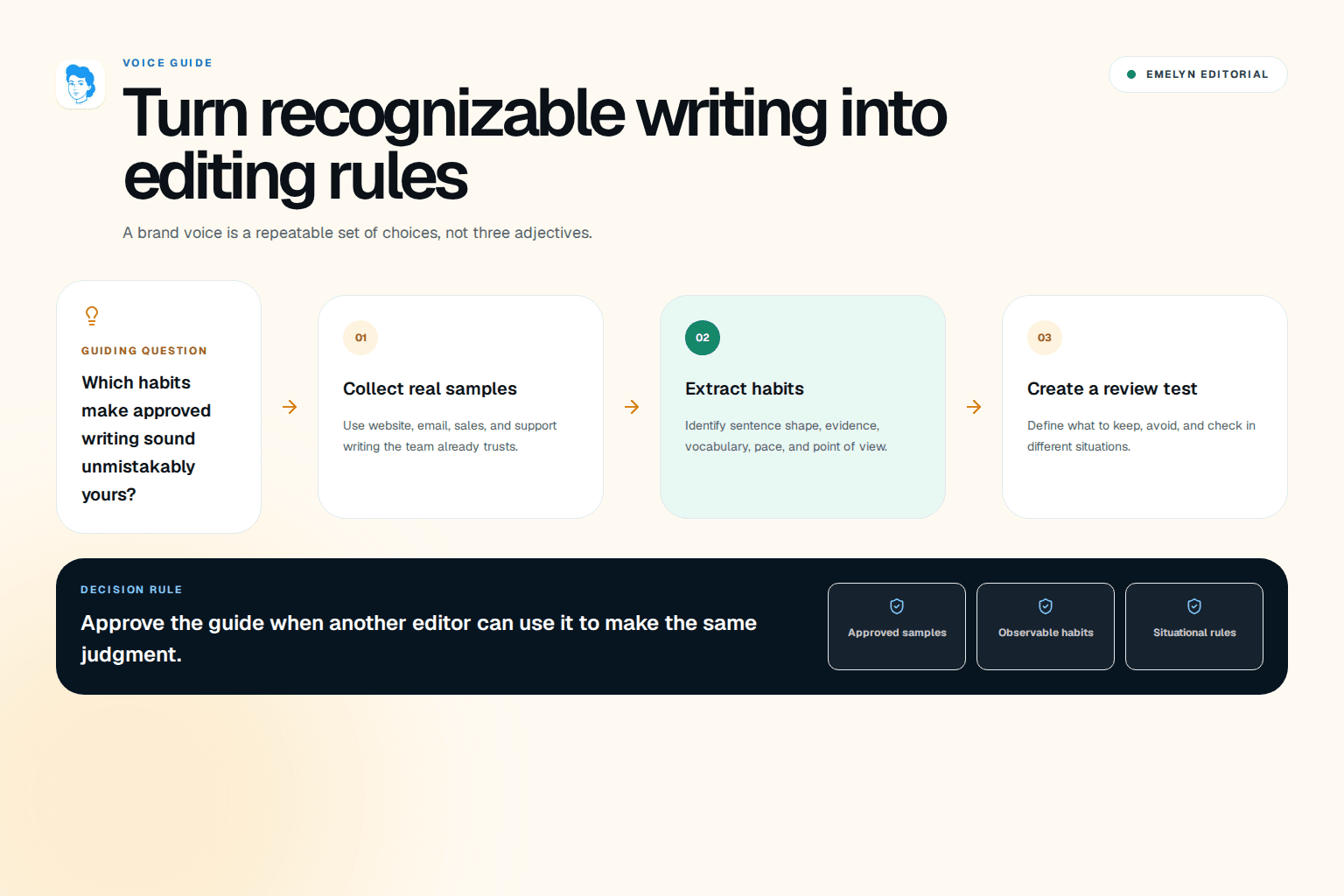
A model can make almost any brand sound “warm” or “professional.” It needs evidence to learn where your version of warm stops, how direct you are, and which details make the writing yours.
Too broad
Warm, confident, approachable, playful.
Thousands of brands can claim the same four words. None of them tells an editor what to change.
Usable
Name the useful detail. Skip the grand promise. Let one dry line carry the humor.
These rules can be checked against a real draft and traced to writing that already works.
01
Choose a small set of writing that clearly sounds right. Keep enough context to show why it works.
02
Show what sounds too polished, vague, salesy, cute, formal, or unlike you—and mark the exact problem.
03
Write down the beliefs and tradeoffs behind the voice. Style without a view becomes decoration.
04
Keep the words customers use for their problem, decision, and desired result.
05
Turn taste into edit checks: sentence shape, detail level, banned phrases, claims, humor, punctuation, and structure.
06
Say what stays constant and what changes across a post, reply, announcement, apology, or support message.
Three approved sentences reveal a practical, quietly confident voice. A rejected sentence shows where it turns into familiar lifestyle copy.
Approved evidence
“Every mug is made to be used, not saved for best.”
“The glaze may vary. That is the point.”
“If a handle feels wrong, tell us. We’ll make it right.”
Rejected evidence
“Elevate your daily ritual with timeless craftsmanship.”
The sentence could sell coffee, candles, towels, or pottery. It hides the useful object behind a familiar promise.
Plain details, useful objects, dry confidence.
Luxury language, breathless launches, vague rituals.
A customer reply is warmer; a product note stays spare.
Do not only feed the guide into generation. Check the finished draft against it, record recurring corrections, and promote only the useful patterns into future rules.
Generic first pass
We’re thrilled to introduce a stunning new collection, thoughtfully crafted to elevate everyday moments.
Edited with evidence
The new breakfast cups are ready. The glaze breaks differently around every rim, so no two came out quite the same.
01
Could this sentence appear on a competitor’s page unchanged?
02
Does it contain a real detail, opinion, or observation?
03
Can every claim be supported by the source beside the draft?
04
Does the rhythm resemble the approved examples, not merely their vocabulary?
05
Did a banned phrase return under a different synonym?
Build the correction loop
Research method: live US-English Google results, competitor product and editorial pages, current Reddit discussions, and local Emelyn prospect evidence checked 29 August 2026. The worked pottery-studio example was created for this guide and does not describe a customer.
HubSpot setup reference Glean voice-guide reference Practitioner voice discussion
Editorial status: author and reviewer unassigned; last checked 29 August 2026. Corrections: hello@emelyn.ai.