
Weekday mornings
Try a morning slot against a midday slot.
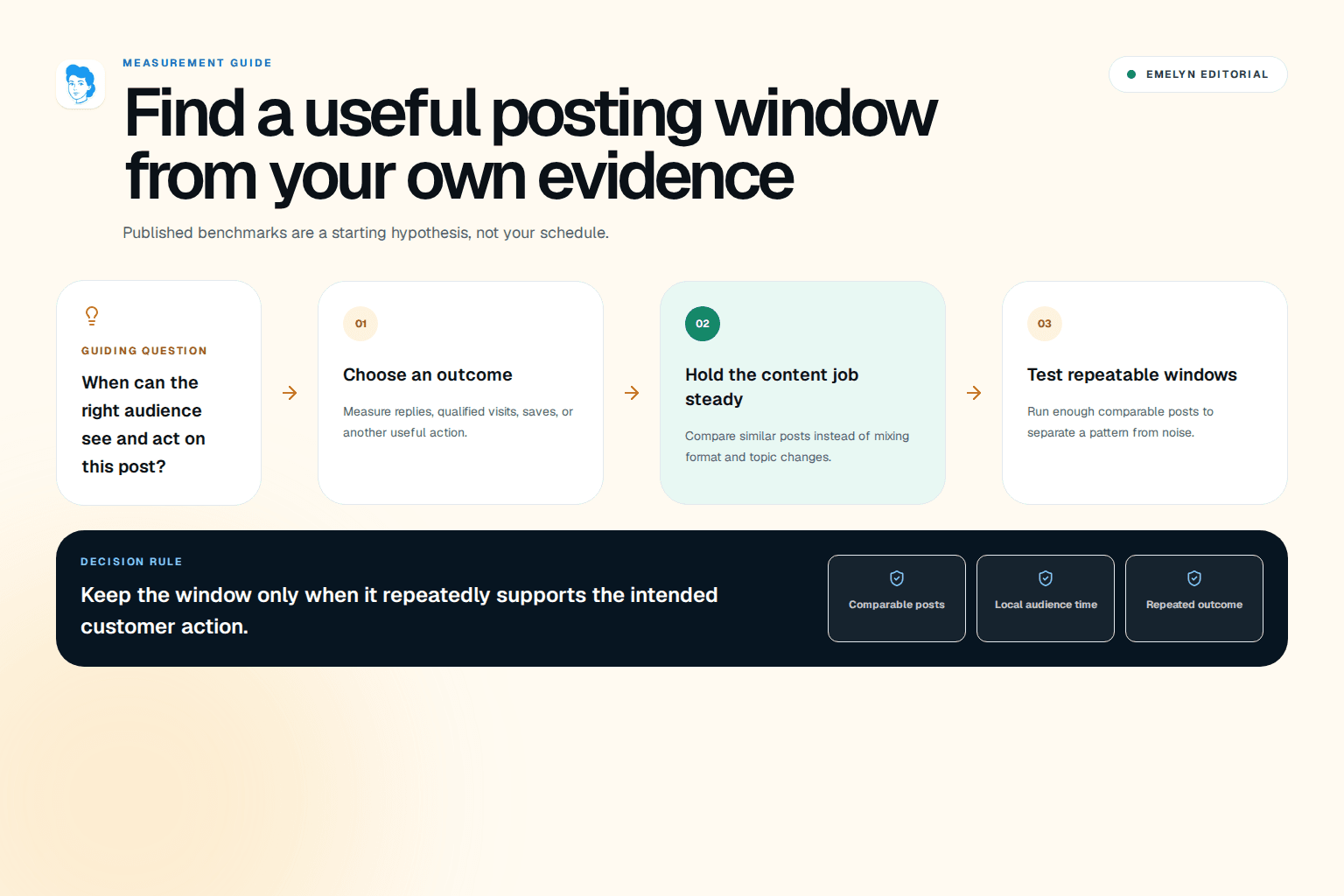
Broad studies are useful starting points, not a schedule for every account. Begin with a likely window for each platform, compare it with your own audience activity, and test similar posts before changing the calendar.
These are simplified local-time windows from Buffer’s 2026 study of more than 52 million posts. They help you choose a first test; they do not promise reach.
Weekday mornings
Try a morning slot against a midday slot.
Weekday morning or early evening
Test around your followers’ active hours.
Midweek afternoon
Compare a workday slot with a later one.
Evenings and weekends
Test when your audience has time to watch.
Friday or Saturday afternoon
Keep Shorts separate from long videos.
Sunday morning or early evening
Give longer viewing its own test.
Weekday mornings
News and live events may matter more than the clock.
Weekday mornings
Compare reach and replies, not likes alone.
Late morning to early afternoon
Test around when people plan, search, and save.
Sprout and Buffer both publish large 2026 studies, yet their suggested LinkedIn windows differ. That does not make either study useless. It means neither dataset is your account.
Sprout Social
Nearly 2 billion engagements across roughly 307,000 profiles, recorded in local time over a three-month period.
Buffer
More than 52 million posts across major platforms, with separate findings for formats such as Shorts and long-form YouTube.
One study can include a different customer mix, time range, metric, or platform behavior. Use the published methodology to choose a starting point, then let your audience settle the schedule.
Use your audience’s active hours when you have them. If you do not, choose two broad benchmark windows in the audience’s local time.
Use the same platform, content job, format, and similar topics. Alternate the two windows instead of putting every strongest post in one slot.
After several posts in each window, compare the measure that fits the job. Keep, retest, or drop a window—then check again when the audience changes.
Worked example
For four weeks, it alternates useful product posts between late morning and early evening. It compares profile visits and reservation clicks—not only likes—and notes sell-outs or paid promotion that could distort a result. If one window repeatedly helps the same job, it earns more of the next month’s schedule.
Research method: live US-English Google results, DataForSEO search intent and volume, the published methods behind current benchmark studies, Reddit practitioner discussions, and local Emelyn prospect evidence, checked 29 August 2026.
Buffer 2026 study Sprout Social 2026 study Audience-data discussion
Editorial status: author and reviewer unassigned; last checked 29 August 2026. Corrections: hello@emelyn.ai.