
Listening question
What makes people hesitate before using social media scheduling software? Sources include selected creator discussions, customer questions, and public product reviews.
Social listening means following chosen public conversations to understand what people care about, where something is changing, and what deserves a response. Emelyn turns the useful evidence into a clear content, product, or customer decision instead of leaving you with a wall of mentions.
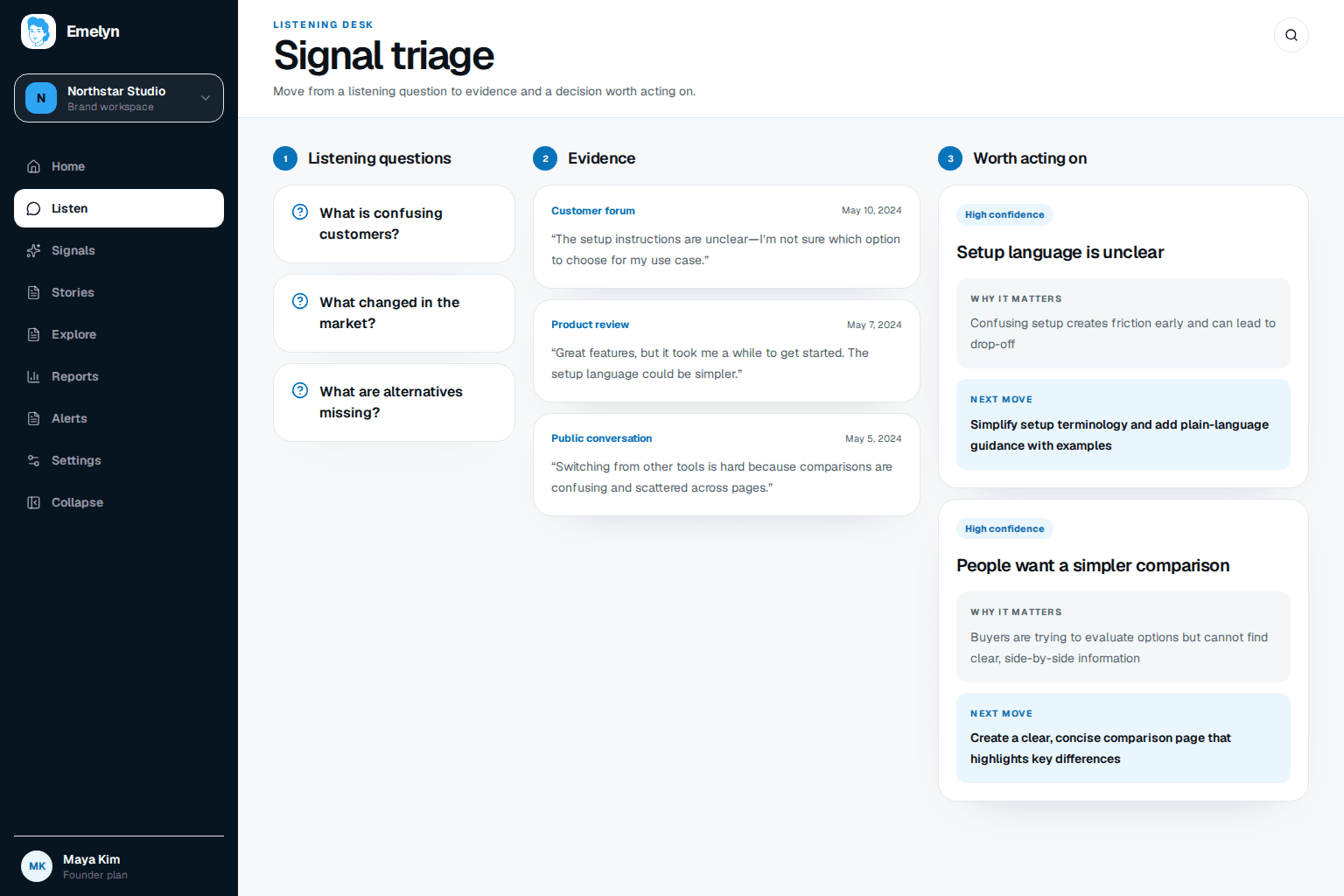
The hard part is rarely collecting more posts. It is knowing which conversations answer something important for your business.
Listen for a buying concern, a customer problem, a market change, or an idea you need to test. A clear question makes irrelevant chatter easier to leave out.
A signal stays attached to the conversations behind it. You can read the words, check the source, and decide whether the pattern is real enough to use.
Turn the finding into one practical choice: answer a question, change a message, investigate a complaint, or watch the pattern for longer.
A repeated concern is more useful when you can see where it came from and decide what kind of answer it deserves.
What makes people hesitate before using social media scheduling software? Sources include selected creator discussions, customer questions, and public product reviews.
People are less worried about choosing a time than losing control when a post fails, publishes in the wrong format, or cannot be checked in the native platform.
Confirm the platform facts, answer the reach question directly, and show how publishing status and manual fallbacks work. Do not make a claim the evidence cannot support.
One evidence-backed explanation, a product-page improvement, and a question worth monitoring after publication.
Emelyn connects listening to the strategy before it and the idea after it, so an interesting post does not become content by accident.
Choose what you need to learn and the people, topics, and sources that may hold the answer.
Bring relevant public posts and discussions together while keeping the original source visible.
Separate repeated evidence from one loud comment, spam, jokes, and unrelated uses of the same words.
Create an idea, flag a customer issue, update the strategy, or wait until the evidence is stronger.
Collection and sorting can run often. Context, empathy, and the decision to respond still need judgment.
Search can find a post. Listening becomes valuable when repeated evidence stays connected to a decision.
| Question | Manual search | Scheduler | AI generator | Emelyn |
|---|---|---|---|---|
| Finds | Posts you have time to search for | Nothing before publishing | Ideas based on your prompt | Conversations tied to a chosen business question |
| Shows evidence | Tabs, bookmarks, and notes | Not included | Often no original source | Source conversations kept beside the signal |
| Handles noise | You filter every result | Not included | May summarize what you paste | Uses your inclusions, exclusions, and examples |
| Ends with | Your own interpretation | A publishing date | A draft | A reviewed signal and a clear next move |
Social listening is the practice of following selected public conversations, finding useful patterns, and using the evidence to make a content, customer, product, or market decision.
Monitoring often focuses on finding individual mentions that may need a reply. Listening looks across selected conversations for patterns that can shape a wider decision. In practice, useful software can support both jobs.
It can find some untagged public mentions when the platform and source make them available. It cannot promise complete coverage, especially for private spaces, restricted APIs, images without readable text, or conversations that use unexpected language.
Begin with the question you want answered. Add the words customers use, common misspellings, product and competitor names, and clear exclusions. Review early results and refine the query from what is actually relevant.
No. A mention can become an alert, a signal, a content idea, or something to ignore. Sensitive replies and unusual situations should remain a human decision.
Turn questions, changes, and lessons from real work into ideas worth making.
See repeated competitor patterns and the useful territory they leave open.
Rebuild one useful source into pieces with different jobs.
Follow a useful signal through creation, review, publishing, and learning.
See where listening sits between strategy and ideas.
Open the exact inputs, outputs, permissions, limits, and weak-confidence behavior.
Keep the original signal, source context, interpretation, and next decision together.