
Approved issue
Draft newsletters stay out unless the workflow explicitly supports pre-publication planning.
Emelyn maps the stories, lessons, frameworks, and questions inside an approved newsletter, then develops only the ideas that can stand on their own.
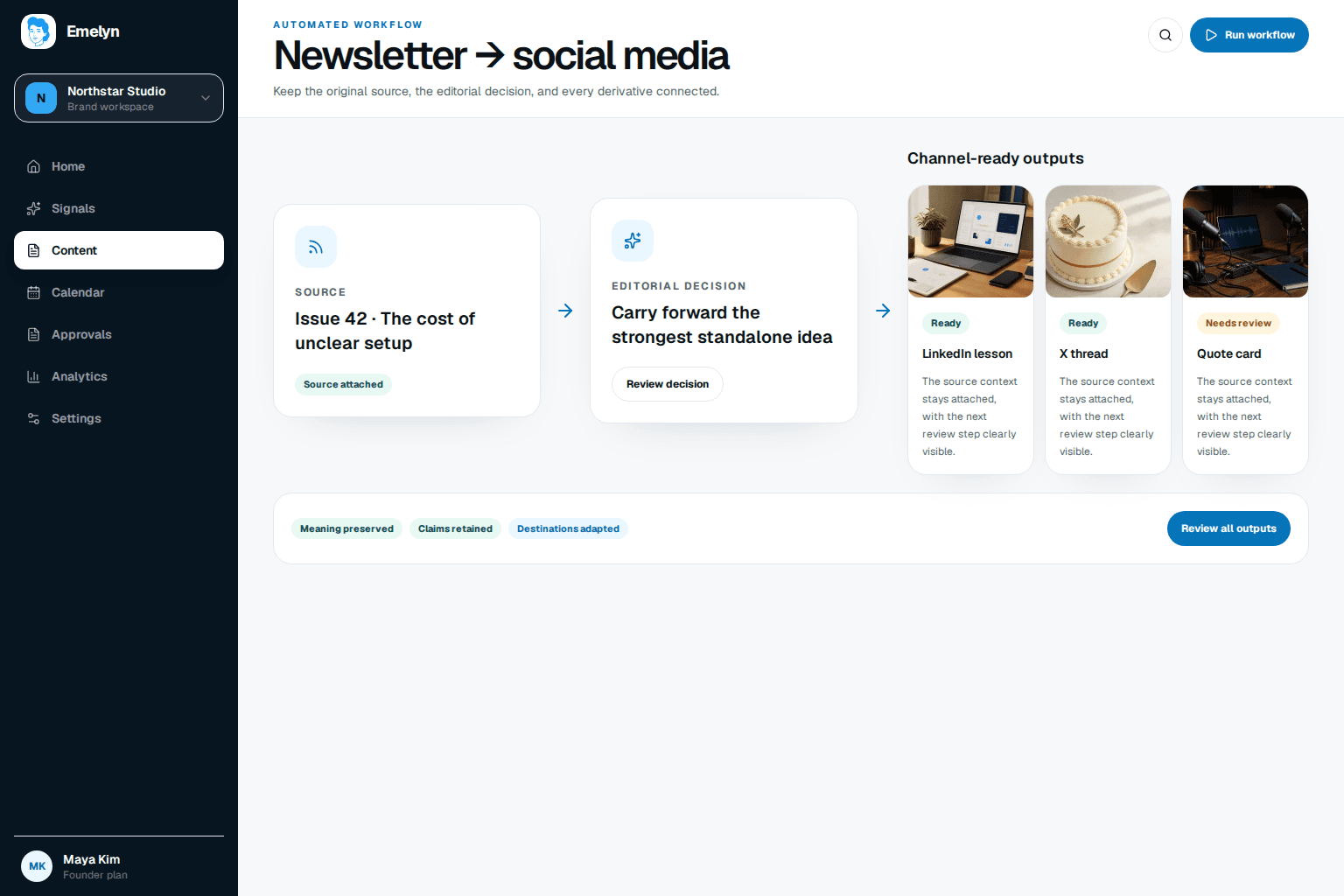
Connect an approved issue or paste the final copy. Add its owner, publication state, source links, reuse rights, and the sections reserved for subscribers.
Draft newsletters stay out unless the workflow explicitly supports pre-publication planning.
Private stories, paid sections, quotations, and third-party images keep their own rules.
Links and claims inside the issue remain connected to the idea that uses them, so an expired source pauses only the affected draft.
“Why good plans survive bad weeks” contains a story, a recovery lesson, a three-part framework, and a reader question. Three of them earn a separate social job.
1. Opening story
The week the plan fell apart.
The minimum viable week
Teach2. Core lesson
Recovery matters more than perfect adherence.
A plan needs a recovery mode
Explain3. Reader question
What do you protect when work gets messy?
A focused discussion prompt
DiscussHeld back: the subscriber-only client example
It helped shape the lesson but cannot appear in public output. The boundary stays attached through drafting and review.
Emelyn spaces three distinct posts around the original issue. It does not create filler to hit a round number.
Mon
No post
Let the issue breathe.
Tue
LinkedIn story
The minimum viable week.
Wed
No post
Do not fill the calendar.
Thu
Instagram carousel
A plan needs a recovery mode.
Fri
No post
Make room for other work.
Sat
Threads question
What do you protect when work gets messy?
Sun
No post
Stop when the source is spent.
The LinkedIn post uses the opening story, the carousel teaches the recovery framework, and Threads asks the reader question. Each carries the source, voice rules, intended job, and review state.
Publishing rule
Review the first issue. Reuse the proven rule.
After the owner approves a repeatable source boundary and channel treatment, future issues can move directly to a ready queue—while private sections, new claims, and unusual formats still stop for review.
A newsletter can produce fewer posts than planned without the workflow treating that as failure.
Keep it out of public output unless the owner explicitly clears it.
Create one good post or none. Do not stretch it into a week.
Hold the dependent claim and keep the rest of the issue separate.
Return to the idea map and give each post one standalone job.
Each post keeps its own job. Compare story replies, framework saves, discussion quality, qualified newsletter visits, and new subscriptions without rolling them into one score.
Strategy update
If recovery frameworks repeatedly travel farther than the issue announcement, make them a recurring social pillar and keep the newsletter as the deeper home.
Newsletter writers describe the repeated work of reformatting for every channel, but the useful response is selective: choose a few points, adapt each one, and protect the voice that made the issue worth reading.
As many as the issue can genuinely support. A short issue may produce one post; a modular, evidence-rich issue may produce several. The calendar should not decide the number.
The post should be useful on its own while making the deeper issue easy to find. Measure both social response and qualified newsletter visits instead of hiding all value behind a click.
Yes. Mark subscriber-only stories, examples, downloads, and sections before drafting. They remain excluded unless someone changes the permission.
Pillar
Choose the parts that can stand alone and leave the rest in the original issue.
ExplorePlatform
Turn one self-contained idea into a LinkedIn post with its own context and purpose.
ExploreIntegration
Map the published issue and avoid starting a new workflow for drafts or silent edits.
ExploreFree tool
Draft one evidence-backed LinkedIn post before building the wider publishing rhythm.
Explore