
202 accepted
Verified, queued, and safe to process asynchronously.
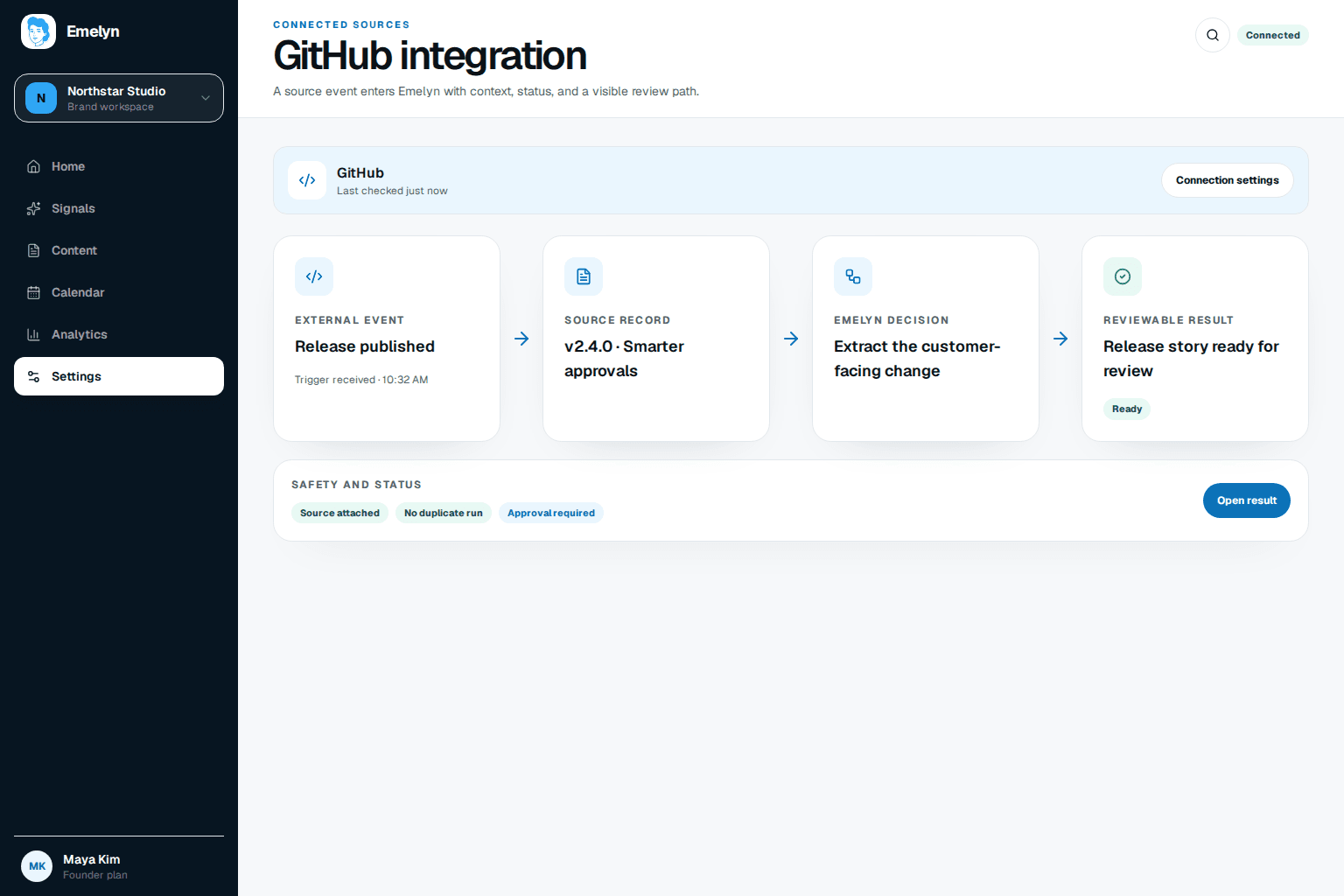
Receive the release once, verify it came from GitHub, keep the original changes attached, and create a reviewable campaign instead of blindly posting a changelog.
Create a repository or GitHub App webhook for the release event. Use JSON, HTTPS, SSL verification, and a high-entropy secret stored outside code.
Use the workspace-specific GitHub webhook URL. Do not add credentials to its query string.
The signature must be calculated over the exact raw UTF-8 request body.
Store the same secret in Emelyn’s encrypted integration credential.
Do not subscribe to every repository event.
Confirm signature, event, delivery ID, mapping, and campaign state before enabling automation.
Drafts and prereleases are ignored in this example. A published release creates a campaign in review mode so product language and promotion level can still be judged.
{
  "action": "published",
  "release": {
    "id": 123456789,
    "tag_name": "v1.4.0",
    "name": "Emelyn v1.4.0",
    "body": "## What's changed
- Added campaign approvals",
    "html_url": "https://github.com/acme/app/releases/tag/v1.4.0",
    "published_at": "2026-08-29T09:30:00Z",
    "draft": false,
    "prerelease": false
  },
  "repository": { "full_name": "acme/app" }
}| GitHub | Emelyn | Use |
|---|---|---|
| action | github.release.action | Must equal published |
| release.id | github.release.id | Stable source identity |
| release.tag_name | github.release.tag_name | Version context |
| release.name | title | Human-readable release name |
| release.body | source_text | Claims and changes to review |
| release.html_url | source_url | Public proof and destination |
| release.published_at | source_published_at | Freshness and ordering |
GitHub recommends HMAC-SHA256 in X-Hub-Signature-256, a constant-time comparison, the unique X-GitHub-Delivery value, HTTPS, and a quick 2XX response.
Connector revision 1.0 · GitHub webhook event schema and REST API version 2022-11-28 · Last tested 29 August 2026.
const signature = request.headers.get("x-hub-signature-256");
const event = request.headers.get("x-github-event");
const delivery = request.headers.get("x-github-delivery");

verifyHmacSha256(rawBody, signature, webhookSecret);
if (event !== "release") return new Response(null, { status: 204 });
await enqueueOnce(delivery, rawBody);
return Response.json({ accepted: true }, { status: 202 });Read release metadata. Repository admin is only needed to create or manage a repository webhook; do not request code write access.
Never log the secret or raw authorization data. Rotate by updating both sides, then send a test delivery.
The delivery GUID connects GitHub’s recent-delivery view to Emelyn’s event log.
Verified, queued, and safe to process asynchronously.
The same delivery or release ID will not create a second campaign.
Missing or invalid signature. Never retry inside Emelyn.
GitHub does not automatically redeliver failures. An admin can redeliver recent webhook deliveries.
GitHub’s own guidance requires signature validation, minimum events, a fast response, delivery IDs, and manual recovery. The content workflow then adds the product judgment developers need: whether the change deserves promotion and how to explain it without release-note jargon.