
01
Audience fit
Does this help the person the strategy chose?
Emelyn ranks ideas by audience fit, evidence, freshness, distinctiveness, and business value. Effort stays separate. You can see why one idea moved up, why another was held back, and what new information would change the order.
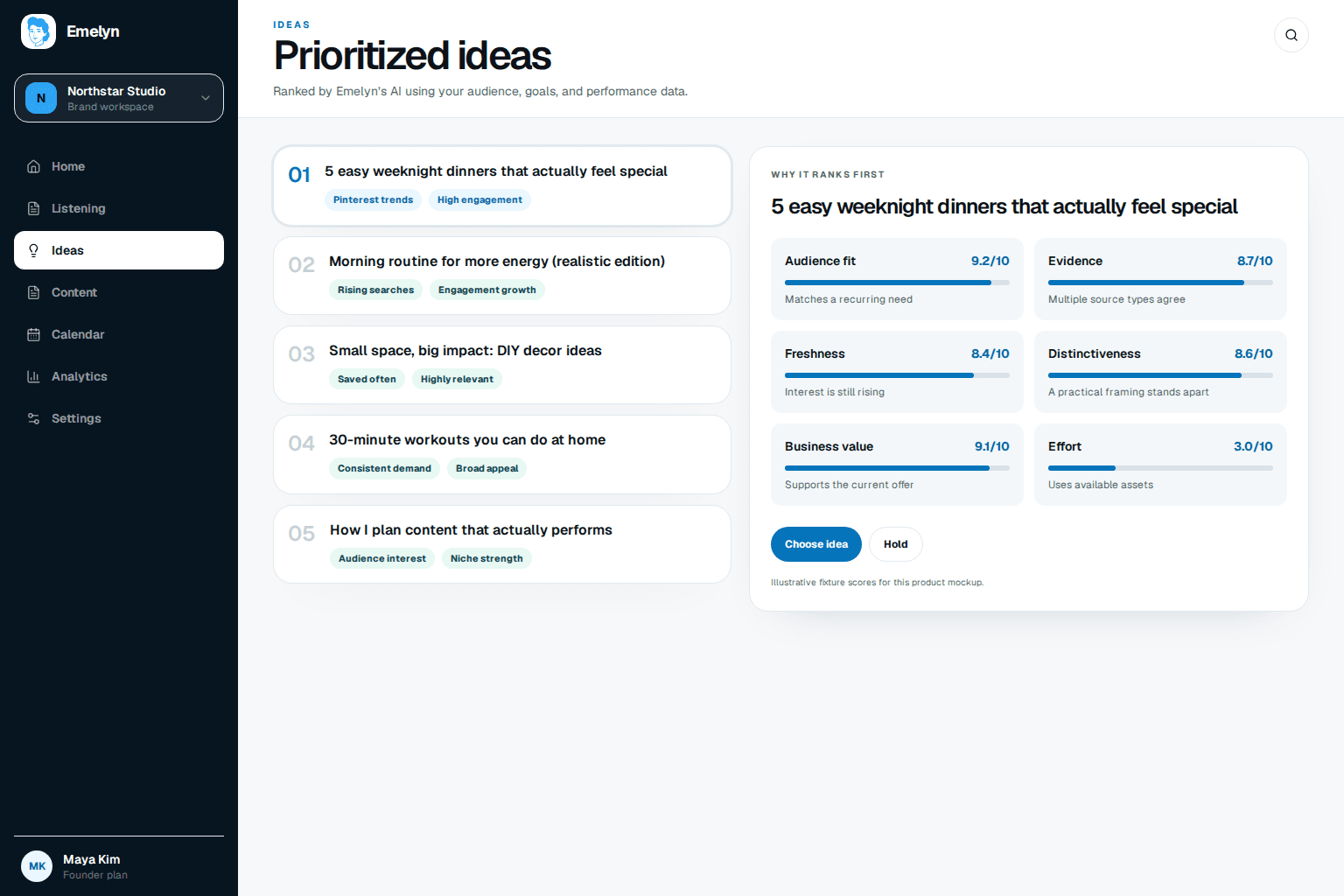
A strong idea can be expensive. A quick idea can be weak. Emelyn keeps value, confidence, timing, and effort visible as different facts.
Does this help the person the strategy chose?
Is the idea supported by something real and inspectable?
Will the reason to care still exist when the work is ready?
Can we add something more useful than a familiar summary?
Could the idea support a relevant decision or action?
What does it take to make this well? Kept separate from value.
01
Question, release, trend, result, or conversation
02
Duplicates and related observations together
03
Value, confidence, freshness, distinctiveness, and effort
04
Research, brief, hold, or reject—with the reason
The score is not the product. The useful output is a small queue whose reasons another person can inspect and challenge.
Workflow 01
A fast-moving topic looks popular, but its relevance to the audience is uncertain.
Publish the timely angle for a clear reason, or skip it without fear of missing out.
Workflow 02
A listening brief produces many questions, objections, and competitor conversations.
A small, explainable queue instead of another folder of saved links.
Saving an idea and approving work are different actions.
A score supports judgment; it cannot measure taste, timing, or political sensitivity perfectly.
Emelyn keeps it in the right state and explains the blocker.
Part of Emelyn. Stored ideas and evaluation usage follow the account limits shown on Pricing.
See pricingThe best idea is often the one that connects current audience need with hard-won expertise—not the one copied from a trend feed.
No. Ranking helps choose what to develop. Publishing still follows the workflow's review and control rules.
Yes. The owner can adjust strategic weights such as audience fit, evidence, freshness, distinctiveness, and business value.
They keep their source and reason. A rejected idea can return if new evidence or a changed strategy makes it relevant.
Use two evidence-led workflows, the idea guide, and a matching business workflow to see prioritization under different pressures.
Practical guide
Collect questions, changes, and lessons from real work, then choose with five clear checks.
ExploreWorked example
Follow a repeated audience need into one focused content idea.
ExploreGap workflow
Rank an unanswered audience need only after your own proof is visible.
ExploreBest-fit workflow
Choose the expert lesson worth developing from calls, frameworks, and questions.
ExploreNext step
Turn an approved idea into a source-backed brief and draft.
ExploreEditable template
Compare patterns fairly, expose the unanswered need, and require your own proof.
Explore