
Map repeated territory
See the topics, promises, proof, formats, and calls to action that appear again and again—not only whichever post has the largest number.
Social media competitor analysis means studying the topics, formats, messages, frequency, and audience responses that comparable businesses repeat over time. Emelyn uses those patterns to reveal crowded territory and open questions, then connects the gap to your own evidence and point of view.
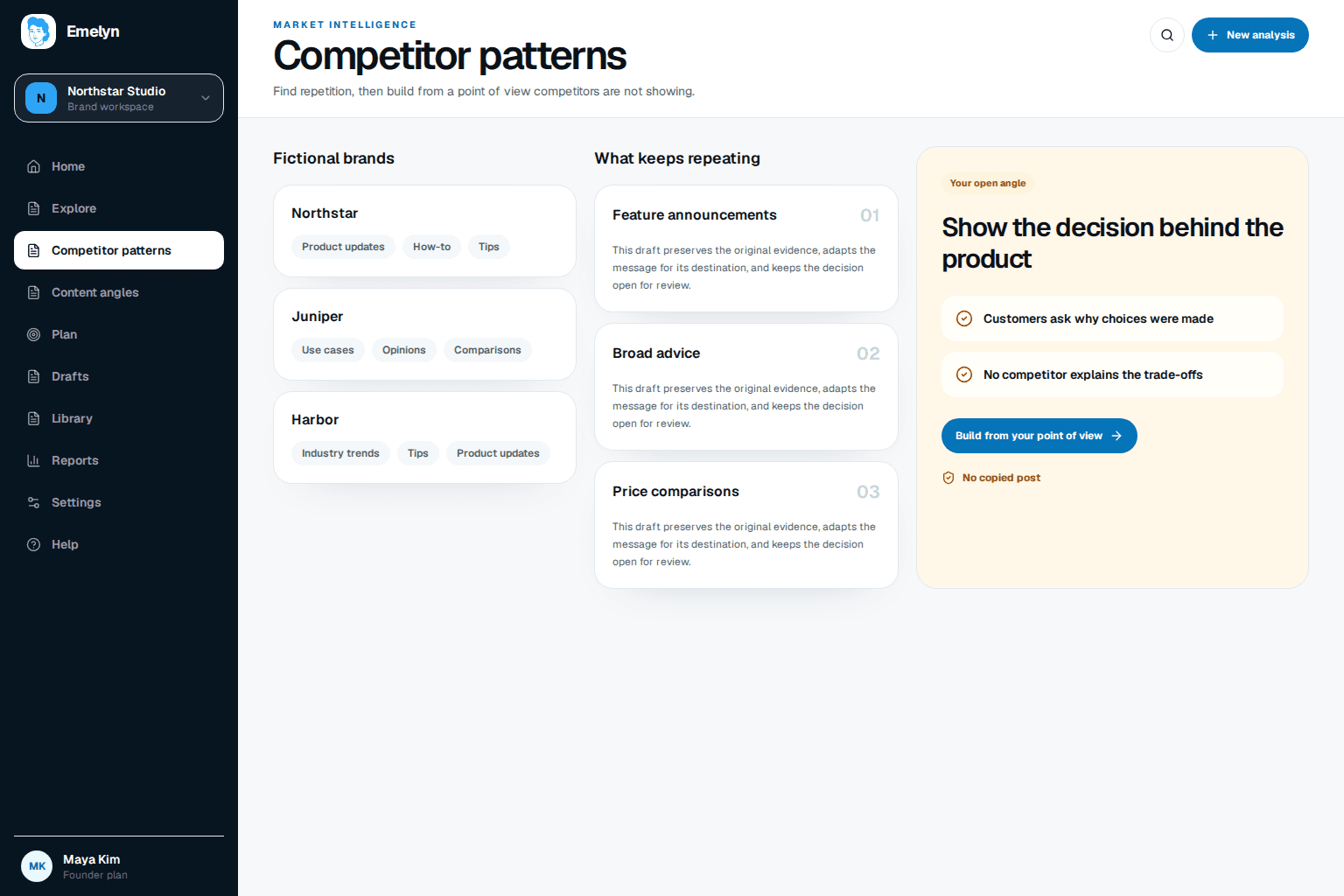
Useful analysis looks across enough time to understand what competitors consistently talk about, how they frame it, and what their audience still asks for.
See the topics, promises, proof, formats, and calls to action that appear again and again—not only whichever post has the largest number.
Look for questions, objections, saves, shares, and conversation quality that reveal what the audience needs beyond the post itself.
Join only where your experience, data, product, or point of view can add something competitors have not already said.
The opportunity is not a sixth version of the same list. It is the unresolved question underneath the repeated topic.
A differentiated guide grounded in your own method—not a rewritten competitor post or a claim about their results.
Competitor posts are one source among many. The strategy and your own evidence decide whether an observed gap is worth using.
Select the businesses, channels, audience, offer, and time period that make the analysis meaningful.
Group recurring topics, formats, hooks, proof, timing, and audience responses instead of chasing isolated winners.
Identify what the audience asks for, what nobody explains well, or where every competitor sounds the same.
Build an angle from your experience and facts, then measure whether the audience finds that difference useful.
Collection and grouping save time. Fair interpretation and the decision to create something genuinely different cannot be handed off blindly.
Counts can show activity. Emelyn connects repeated public evidence to the content territory your business should enter or leave alone.
| Analysis job | Manual review | Scheduler | AI generator | Emelyn |
|---|---|---|---|---|
| Looks at | Profiles and posts you inspect | Your own publishing queue | Whatever you describe in a prompt | Chosen competitors, patterns, responses, and time periods |
| Finds | Observations in your notes | Not included | Possible content ideas | Crowded territory, unresolved questions, and credible gaps |
| Protects originality | Your own discipline | Outside its job | Can imitate the prompt too closely | Requires your evidence and point of view before creating |
| Ends with | A report or rough idea | Nothing about competitors | A draft | A differentiated angle and a hypothesis to test |
It is the study of comparable businesses' public social content, repeated messages, formats, frequency, audience responses, and visible changes in order to understand crowded territory and possible opportunities.
Track repeated topics, message, proof, format, posting pattern, call to action, meaningful audience questions, and changes over a useful time period. Choose fields that answer a strategic question rather than collecting every available metric.
Use a period long enough to reveal repetition. A monthly or quarterly review may be enough for a stable market, while a launch or fast-changing category may need closer monitoring. Avoid changing your plan because of every individual post.
You can use public activity to understand a topic or unresolved question. Your final content should come from your own evidence, experience, examples, and point of view rather than copying their wording, creative, or distinctive idea.
Not necessarily. Public engagement can reflect audience size, paid distribution, topic, timing, controversy, or other factors. It does not show private outcomes such as qualified leads, retention, or revenue.
Include customer conversations and market changes beyond competitor feeds.
Develop your own strong sources into distinct pieces.
See whether the differentiated idea helped the intended goal.
Follow research into ideas, content, publishing, and learning.