
The lesson
State what changed in your thinking and why the reader should care, without withholding the whole idea.
Watch your public publication feed, find several useful angles inside each new issue, and build a reviewable sharing queue instead of one repetitive announcement.
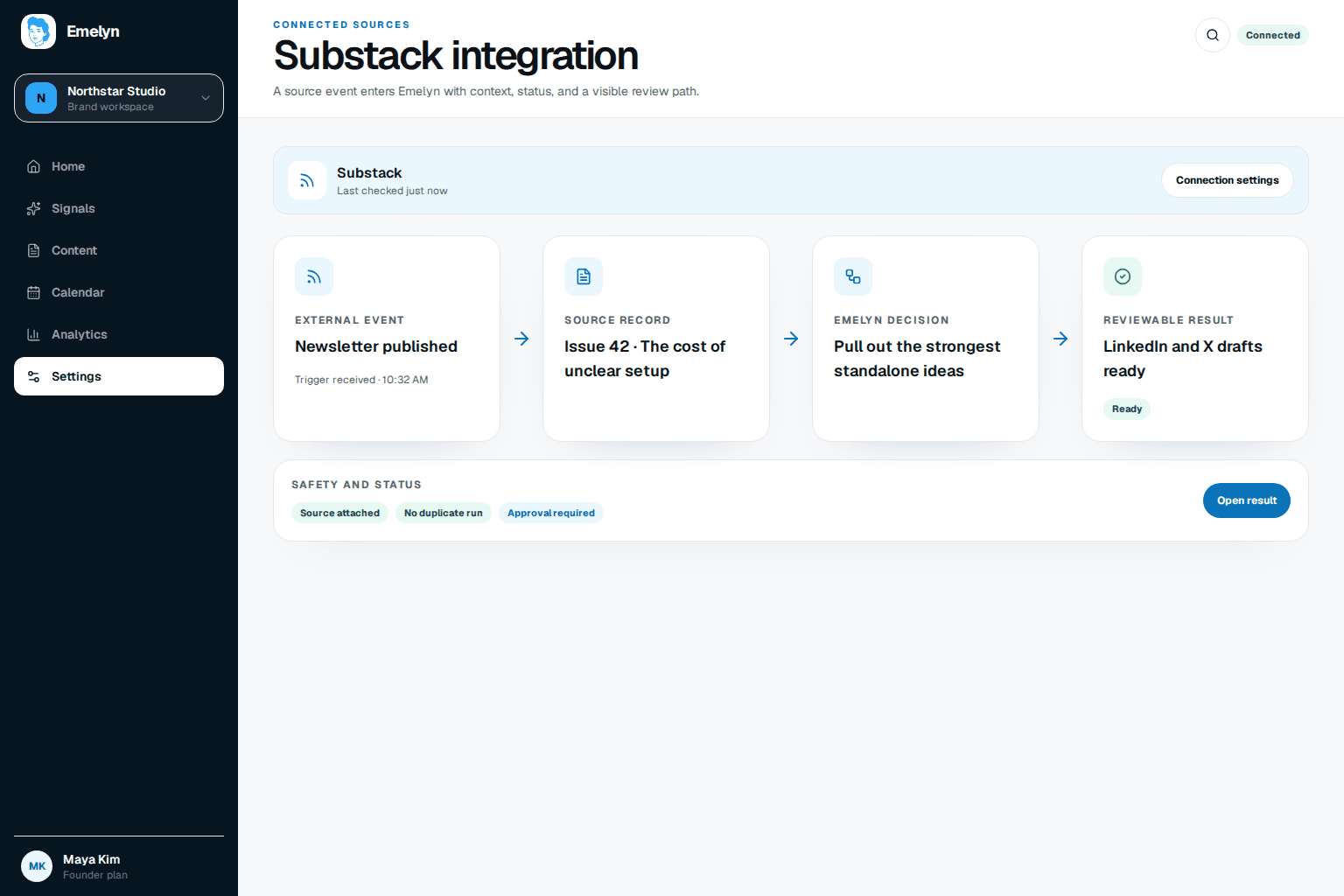
Every Substack publication has a feed at its publication domain followed by /feed. Emelyn reads that public feed, so this workflow does not ask for your Substack password or pretend there is a publishing API connection.
Public issues onlyThe feed is the boundary. Private drafts, subscriber emails, audience lists, and unpublished Notes are not fetched.
{
  "publication_url": "https://your-publication.substack.com",
  "feed_url": "https://your-publication.substack.com/feed",
  "check_every_minutes": 15,
  "new_issue_action": "prepare_7_day_campaign",
  "angles": ["lesson", "surprising_quote", "practical_takeaway"],
  "channels": ["linkedin", "threads", "instagram"],
  "review_required": true,
  "dedupe_by": ["guid", "canonical_url"]
}
Publication recipe revision 1.0 · Substack publication RSS · Last tested 29 August 2026.
The first useful job is choosing what the issue contains that deserves its own conversation. Emelyn proposes angles and shows the supporting passage before drafting.
State what changed in your thinking and why the reader should care, without withholding the whole idea.
Use a short, attributable passage as the start of a conversation—not as empty quote-card decoration.
Turn one method or decision into something a reader can apply before they click.
Each public item becomes one source record. Its fields stay attached while Emelyn creates a seven-day queue with different angles, formats, and posting times for the channels you chose.
| Substack feed | Emelyn | Use |
|---|---|---|
| guid | substack.issue_id | Saves the issue identity |
| link | source_url | Keeps the public issue as the destination |
| title | source_title | Names the subject; not copied into every caption |
| description or content | source_text | Supplies the public excerpt or body available in the feed |
| pubDate | source_published_at | Starts the sharing window |
| enclosure | source_media | Uses the issue image when the feed provides one |
This is a starting sequence. Review, remove, or reschedule any draft before publishing.
The connection makes its intake state visible and stops safely when the publication or item cannot be read.
Ignore the repeat and keep the existing campaign. A feed reorder is not a new issue.
Back off and retry. Keep the last checkpoint; do not mark old issues as new.
Draft only from the public text returned. Never invent the hidden part of a paid issue.
Flag the campaign and destination link for review. Do not keep scheduling promotion blindly.
What this does not do: publish Substack Notes, read subscriber data, alter your publication, open paid content, guarantee a feed refresh time, or turn every issue into the same captions. The source must be yours or one you are allowed to repurpose.
Substack writers ask for a setup that notices new issues, lets them customize the caption, spaces promotion over time, and preserves their voice. The connection uses Substack’s documented publication feed and keeps private account data out of scope.